

Small kitchens do not lack cabinets. They lack cabinets that work. The shelves are too tall for the things on them, the corner swallows pots whole, and the lids live in a pile that collapses every time you reach for one. The fix is rarely a renovation — a few cheap organizers, a clear plan, and one honest afternoon of sorting.
The 15 kitchen cabinet organization ideas below are made for small kitchens, where every inch has to earn its place. Each one is renter-friendly, inexpensive, and easy to undo — pick the three that solve your biggest daily annoyance, and the rest of the kitchen will feel calmer almost immediately.
Why Kitchen Cabinet Organization Changes How You Cook
An organized cabinet changes how you move through a meal. When the pan you need is at the front instead of buried under four others, you cook more and dread the kitchen less. When every shelf has one job, putting the shopping away takes five minutes, and nothing gets bought twice. Organize by how you use things — breakfast together, baking together, everyday dishes where your hands reach without thinking — and that one rule does more than any single product ever will.
15 Kitchen Cabinet Organization Ideas for Small Kitchens
Upper Cabinets
1. Add Stackable Shelf Risers
Most upper cabinets waste half their height: plates stack six inches high, but the shelf above sits empty for another ten. A stackable shelf riser splits that dead space into two levels, so bowls live on the riser, plates underneath, and nothing is buried.
Practical note: Wire or bamboo risers, no tools needed. Measure first — a riser needs about 8 inches of clearance above it — and choose a foldable style if you rent.

2. Zone Each Cabinet by How You Use It
A cabinet that holds a bit of everything holds nothing well. Give each upper cabinet one job: nearest the dishwasher for everyday dishes, by the stove for oils and spices, over the coffee maker for mugs and breakfast things. When a shelf has a single purpose, you stop hunting and start reaching.
Practical note: Map your zones before you buy anything: stand where you cook, wash up, and make coffee, and assign the nearest cabinet to that task. Our small kitchen organization ideas plan the whole room around the same zone rule.

3. Decant Dry Goods Into Clear Containers
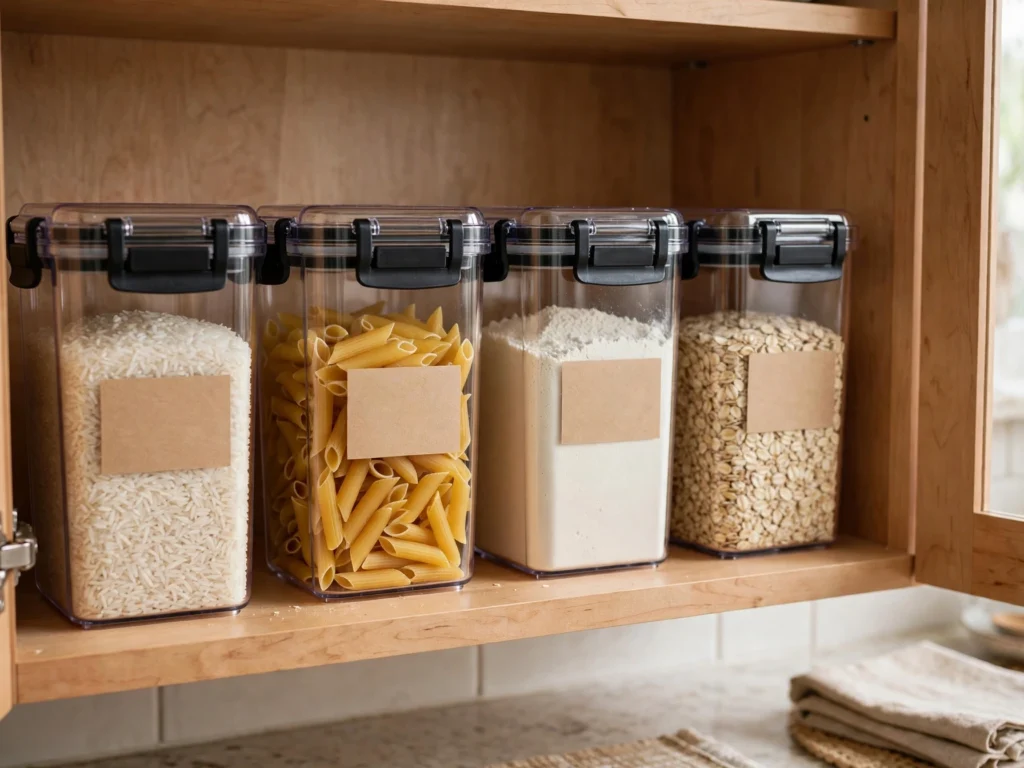
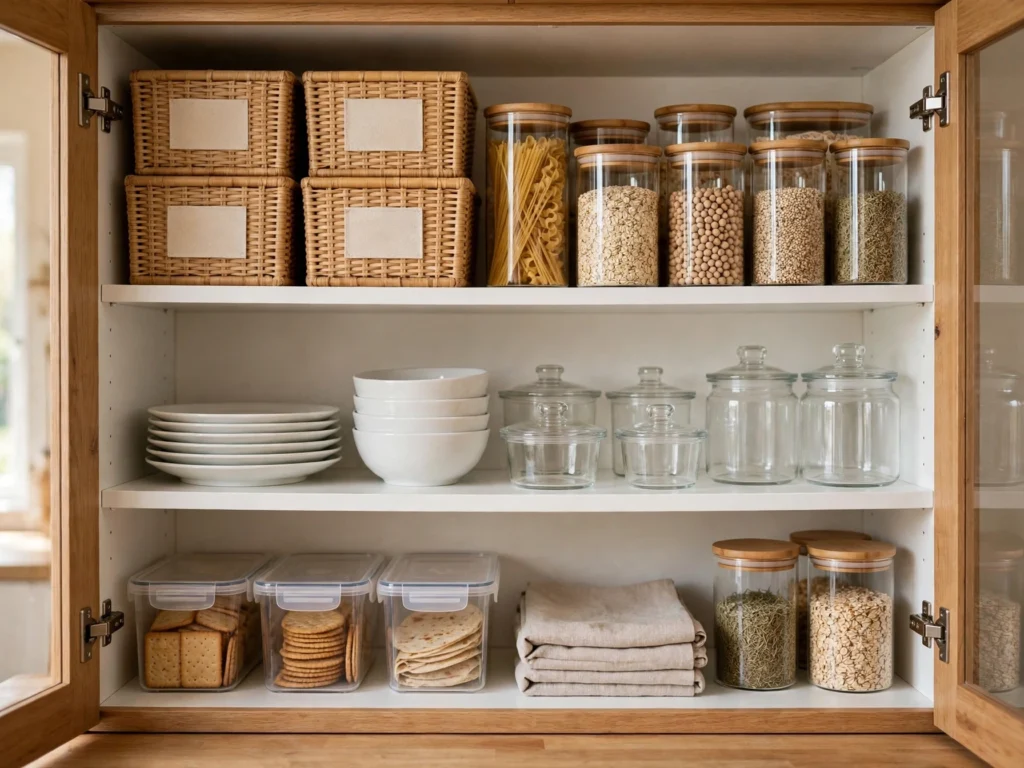
Bags of rice, half-open boxes of pasta, and flour sacks that never close properly make a cabinet feel chaotic fast. Clear airtight containers fix it at once: you can see what you have, everything stacks neatly, and nothing spills when you pull a jar forward.
Practical note: Square containers waste less space than round ones. Label each with its contents and fill date, and keep daily-use containers at the front.
4. Put a Turntable in the Corner Cabinet
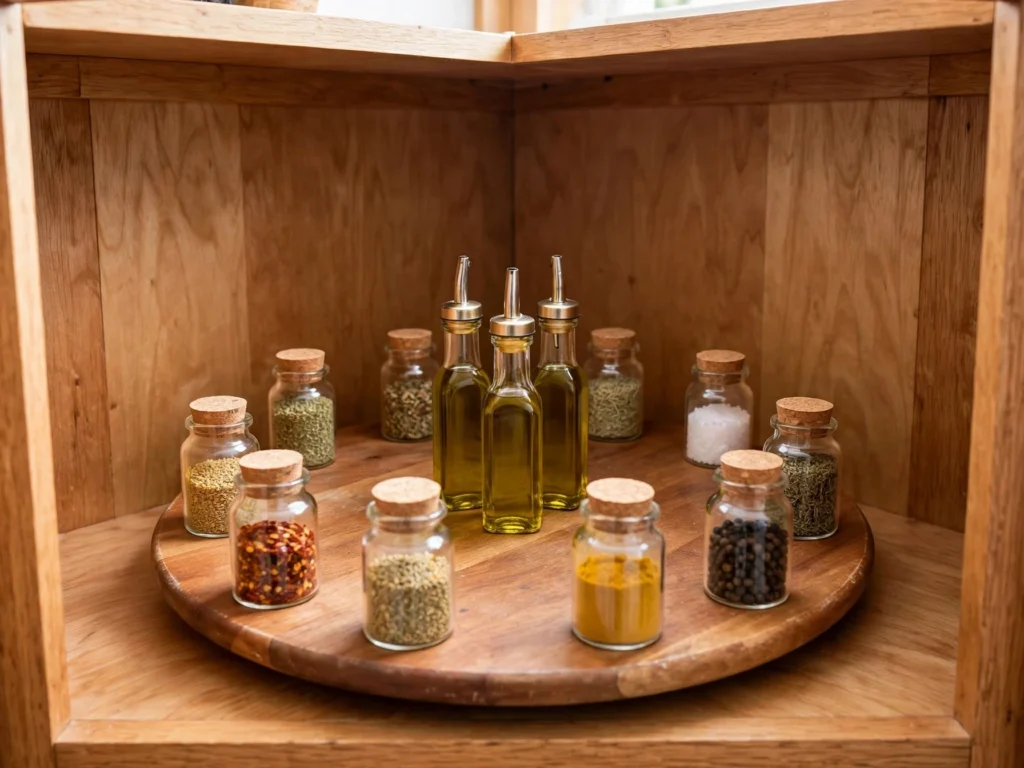
Corner upper cabinets are where spices go to be forgotten. A small turntable changes that: one spin brings every jar to the front, and nothing hides at the back. It is the cheapest fix for the most annoying cabinet in a small kitchen, and works just as well for oils, sauces, and vitamins.
Practical note: A 10-inch turntable fits most upper cabinets — measure the shelf depth first. Choose one with a low rim so jars cannot slide off, and keep the tallest bottles in the center so they never catch the shelf above.
Lower Cabinets & Corners
5. Install Pull Out Sliding Shelves
Lower cabinets are deep, dark, and hard to reach into — which is why the back half of yours is probably a mystery. A pull out sliding shelf turns the whole cabinet into a drawer: it glides toward you, everything comes into the light, and pots, pans, and small appliances become easy to grab and put away.
Practical note: No-drill baskets suit renters; screw-in versions are sturdier for heavy pots. Measure the cabinet opening, not the interior, and leave a finger’s width of clearance on each side so the shelf never sticks.

6. Use Deep Drawer Dividers for Pots and Pans
If your kitchen has deep drawers instead of lower cabinets, treat them like the storage goldmine they are. Adjustable dividers keep pots, pans, and lids in their own lanes, so nothing slides around or nests into a stuck-together tower. A drawer you can see at a glance beats a cabinet you have to kneel to search.
Practical note: Bamboo dividers adjust to fit, no screws needed. Put the heaviest pans at the bottom and the lids in their own section — lids stored flat on top of pans are the number one cause of drawer jams.

7. Tame the Blind Corner With a Pull Out
The blind corner is the Bermuda Triangle of small kitchens: a deep, dark space where baking dishes disappear for years. A two-tier pull out basket is made for exactly this spot — it slides out in stages, bringing the back of the corner forward, so every dish is reachable without crawling halfway inside.
Practical note: Measure the corner opening carefully — pull outs come in left and right versions. Use the lower tier for heavy roasting pans and the upper tier for lighter baking dishes, so the mechanism glides smoothly.

8. Store Lids Upright in a Lid Organizer
Lids are the smallest item in the kitchen and the biggest source of cabinet chaos. Stacked flat, they slide; piled in a heap, they avalanche. A vertical lid organizer holds each lid upright in its own slot, like books on a shelf, so you can pull out the one you need without disturbing the rest.
Practical note: Adjustable wire racks fit more lid sizes than fixed ones. Keep the lids with the pans they belong to — lids in one cabinet and pans in another is how lids get lost. For the full drawer plan, see our kitchen drawer organization ideas.

9. Stand Baking Sheets and Trays on Their Sides
Baking sheets, trays, and cutting boards stacked flat are a daily frustration: the one at the bottom is always the one you want. Vertical dividers turn the stack into a row, each sheet standing on its edge in its own slot, so you slide out the one you need like a book from a shelf.
Practical note: Tension-style dividers need no screws and adjust to any width. Put the most-used tray nearest the oven, and keep cutting boards in the same row so the whole baking station lives in one place. Our kitchen counter organization ideas keep the same tools within reach while you work.

Doors & Vertical Space
10. Mount a Spice Rack on the Cabinet Door
The inside of a cabinet door is free storage space most kitchens never use. A slim spice rack mounted there holds a dozen jars at eye level, frees a whole shelf for dishes, and puts every spice where you can read its label while you cook — one of the highest-impact, lowest-cost ideas on this list.
Practical note: Adhesive or over-the-door racks suit renters; screw-mounted ones suit owners. Keep the rack shallow — jars deeper than 2 inches can stop the door from closing — and store only spices here, not heavy bottles.

11. Hang Measuring Cups on Hooks Inside the Door
Measuring cups and spoons are small, light, and endlessly annoying to dig out of a drawer. A row of small adhesive hooks on the inside of a cabinet door gives each one a home: they hang in a neat line, visible the moment you open the door, and the drawer they used to live in is suddenly free.
Practical note: Adhesive hooks hold well and remove cleanly. Hang cups by size, largest at the back, and keep the set near the baking cabinet so measuring and mixing happen in the same spot.

12. Keep Wrap, Foil, and Bags on a Door Rack
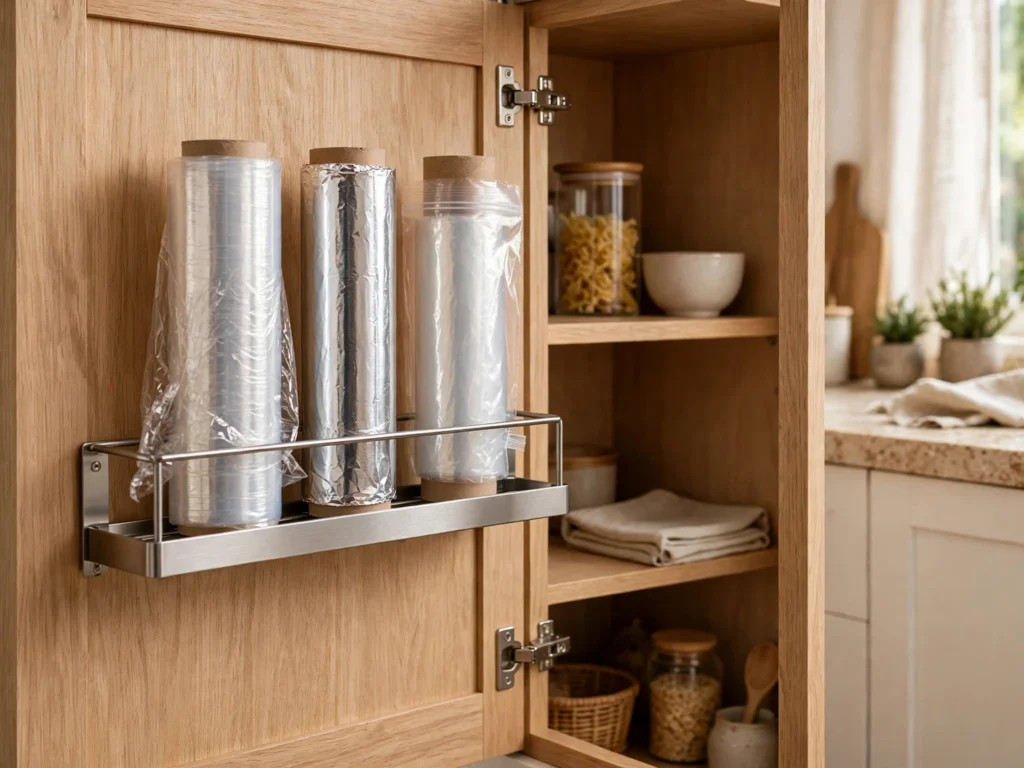
Plastic wrap, aluminum foil, and food storage bags come in long awkward boxes that never fit anywhere sensible. A door-mounted rack holds all three rolls in one slim unit on the inside of a cabinet door, with a cutter edge for the foil and wrap — and you always know when a roll is running low.
Practical note: Measure the door’s interior width first — most racks need about 12 inches. Mount it on a lower cabinet door near the food prep area, and keep the rack low enough that the door still closes fully.
Everyday Systems
13. Corral Small Items in Clear Bins
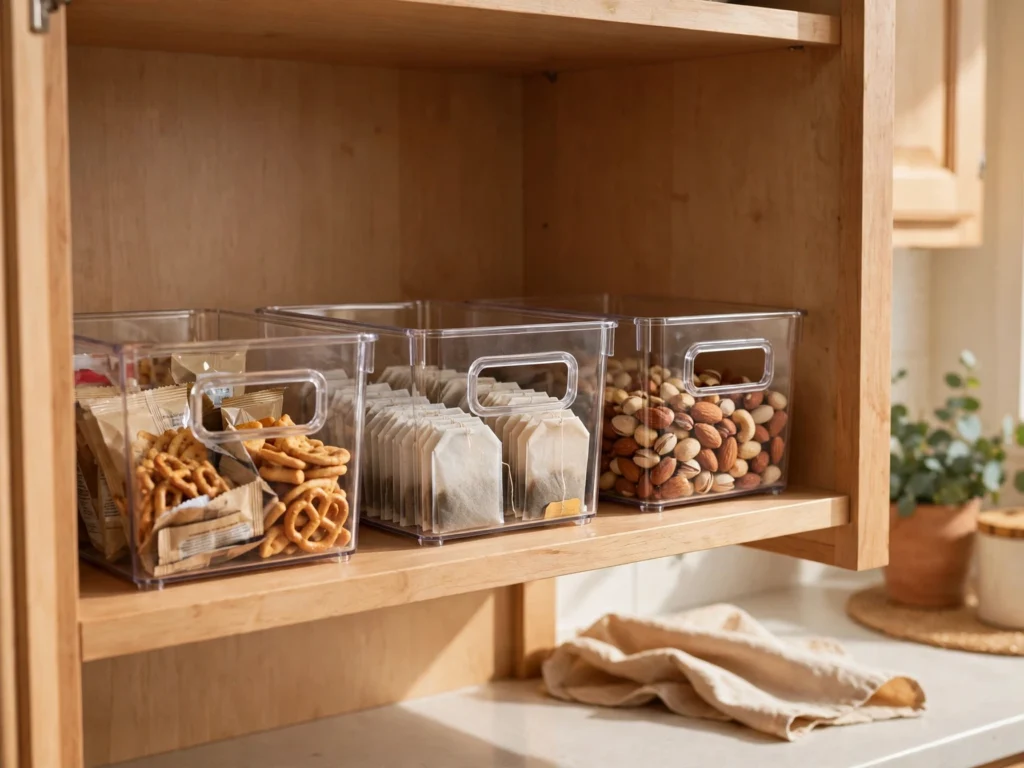
Snack packets, tea bags, sauce sachets, and spice refills are too small for a shelf and too many for a pile. Small clear bins give each category a home: one for snacks, one for tea and coffee, one for baking extras. When something runs out, you see the empty bin and add it to the list.
Practical note: Bins with handles pull out like drawers — handy on a high shelf. Label each bin on the front, and keep only one category per bin — a mixed bin is just a tidy-looking junk drawer. For the trickiest cabinet of all, our under kitchen sink organization ideas use the same bin system.
14. Keep Daily Items at Eye Level
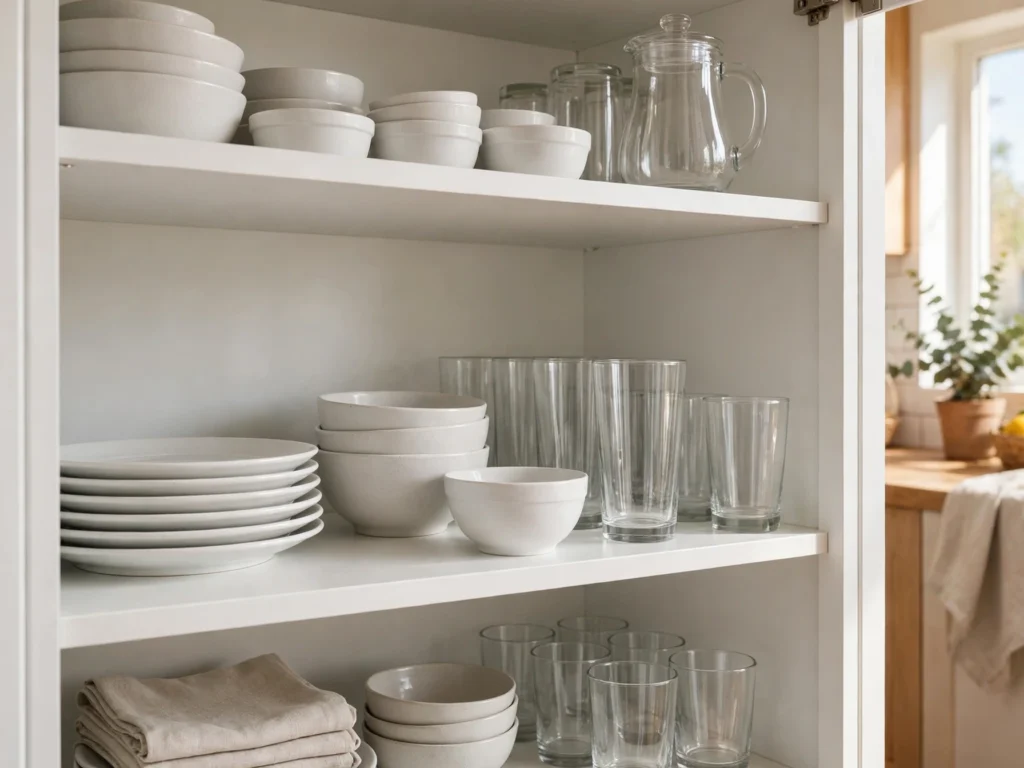
The most-used things in your kitchen deserve the easiest spot. Everyday plates, bowls, and glasses belong on the middle shelf, at eye level, where you can reach them without a step stool or a crouch. The top shelf is for once-a-month items, and the bottom shelf for heavy things you lift with two hands.
Practical note: Audit quickly: anything untouched in a month moves up or out. Keep the coffee mugs nearest the coffee maker and the plates nearest the dishwasher, so the shortest path is always the one you take.
15. Run a Five Minute Weekly Cabinet Reset
Even the best-organized cabinet drifts. Things migrate, new purchases squeeze in, and the system quietly falls apart. A five-minute weekly reset keeps it honest: pull out anything that does not belong, wipe the shelf, return strays to their zones, and take out anything unused for a month. Five minutes a week beats a full-day reorganization every six months.
Practical note: Pair the reset with another weekly habit, like taking out the recycling. And use the one-in-one-out rule: every new gadget that enters the kitchen means an old one leaves. A small kitchen stays organized only if the number of things in it stays roughly the same.
Kitchen Cabinet Organization Tips That Actually Work
- Measure before you buy anything. Cabinet interiors vary by an inch or two — the difference between an organizer that glides and one that sticks.
- Empty the cabinet completely first. Pull everything out, wipe the shelves, and only put back what you actually use.
- One category per shelf, no exceptions. When a shelf has one job, anyone can put things away correctly.
- Use the vertical space, not just the shelves. Risers, hooks, door racks, and stackable bins add storage without adding cabinets.
- Keep the counters clear by giving everything a cabinet home. If a gadget lives on the counter because it has no cabinet spot, the cabinet is the problem. Our kitchen counter organization ideas finish the job.
Once the cabinets are sorted, our Christmas kitchen decor ideas and our Halloween kitchen decor for apartments dress up the room without disturbing the system. Our easy fall home decor ideas for 2026 show how small changes make a big difference.
Kitchen Cabinet Organization FAQs
What is the best way to organize kitchen cabinets in a small kitchen?
Empty one cabinet at a time and group like with like. Then add one organizer per problem: shelf risers for tall shelves, pull out shelves for deep lower cabinets, and door racks for the inside of doors. Keep daily items at eye level, rarely used items up high, and a label on every bin.
How do I organize kitchen cabinets without spending a lot?
Start with what costs nothing: empty the cabinets, donate what you do not use, and reassign shelves by zone. Then buy the cheapest high-impact organizers first — shelf risers, a turntable, and small clear bins — which together cost less than one takeout dinner. Our cheap DIY Christmas home decor uses the same small-budget thinking, and our Black Friday checklist helps you plan bigger purchases, like pull out shelving, for the best sale prices.
How do I keep kitchen cabinets organized long term?
Run a five-minute weekly reset, and use the one-in-one-out rule for every new item: when a new gadget, pan, or container enters the kitchen, an old one leaves. Small kitchens stay organized only when the number of things inside stays roughly constant — the system matters less than the habit.
Should I organize kitchen cabinets by category or by use?
By use, every time. Categories are for stores; kitchens run on routines. The breakfast things live together because you use them together, even if that means mugs next to cereal bowls next to the coffee. Organize around the tasks — cooking, baking, breakfast, cleaning — and the cabinets will make sense to everyone.
Final Thoughts
Kitchen cabinet organization is not about owning the prettiest containers. It is about knowing where things are, reaching them without a struggle, and putting them back without thinking. A riser here, a pull out there, a rack on a door — small fixes, one cabinet at a time.
Start with the cabinet that annoys you most, today. Empty it, sort it, and give everything inside a real home. If you are planning a bigger kitchen refresh around the sales, our Black Friday home decor on a budget shows how to upgrade affordably — then do the next cabinet tomorrow.
Save this post to your kitchen board and organize the first cabinet this weekend.


7 Comments