

A small kitchen does not need more space. It needs a better system. When every pan, spice jar, and cereal box has a home you can reach without moving three other things, cooking stops feeling cramped and starts feeling calm.
The 20 small kitchen organization ideas below are practical, affordable, and made for real kitchens: rentals, apartments, and older homes with awkward corners. No renovation is required. Pick one idea today, try it for a week, and add the next one only when the first has become a habit.
Why a Small Kitchen Needs Zones, Not More Stuff
A small kitchen fails when everything lives everywhere. The mugs are in three cabinets, the baking trays are behind the pots, and the cleaning sprays are buried under plastic bags. You spend more time searching than cooking, and the counter slowly disappears.
Zones fix that. Give each job its own small area — cooking by the stove, prep by the sink, coffee in one corner — and keep only the tools for that job there. When a zone holds five things instead of twenty, you can find everything in seconds.
20 Small Kitchen Organization Ideas That Actually Work
Cabinets & Storage
1. Zone Your Cabinets by How You Cook
Sort your cabinets the way you actually cook. Put everyday plates and glasses near the sink, pots and pans near the stove, and food near your prep counter, so you are not crossing the kitchen with every ingredient.
This one change removes most of the daily hunting. You stop opening four doors to make one meal, and you stop stacking heavy pots on top of the plates you reach for every morning.
Practical note: Keep the most-used items between waist and shoulder height. Store rarely used things, like the turkey roaster, on the highest shelf.

2. Add Stackable Shelf Risers Inside Cabinets
A shelf riser is a small shelf that sits inside a cabinet and doubles its usable surface. It turns one tall, wasted shelf into two levels: mugs on top and plates below, or spices above and oils below.
Risers are cheap, need no screws, and move with you when you move home. Measure the inside height first, then choose a riser that leaves room for the tallest item on the lower level.
Practical note: Choose sturdy metal or bamboo risers, not flimsy plastic. For a full cabinet plan, see our kitchen cabinet organization ideas.

3. Give the Corner Cabinet a Lazy Susan
Corner cabinets are where small kitchens lose things. A lazy Susan — a round turntable that spins — brings the back of the corner to you, so oils and spice jars stop disappearing behind each other.
Pick a turntable with a low rim so bottles cannot slide off, and keep tall bottles in the centre where they are most stable. The same trick works in a deep pantry cabinet.
Practical note: Measure the cabinet opening before you buy; a turntable that is too wide will not fit through the door.

4. Store Food in Clear, Labelled Containers
Clear containers turn a pantry from a guessing game into a quick glance. When you can see the rice, pasta, and cereal, you stop buying duplicates and opening five boxes to find one ingredient.
Label each container on the front, and use square containers, which waste less space than round ones. Decant only the dry goods you use often.
Practical note: Start with five containers for rice, pasta, flour, sugar, and oats, and add more only when those five work well.

5. Stand Baking Sheets and Lids Upright
Baking sheets, cutting boards, and pan lids take up far less room standing on their edges than lying flat in a stack. A simple vertical file organizer holds them upright inside a cabinet, so you can slide out one tray without lifting the whole pile.
Sort them by size, tallest at the back, and leave a little space between them so they do not jam. If your cabinet is too short, store tall trays in the narrow gap beside the fridge.
Practical note: A tension rod across a deep cabinet also makes a cheap divider: slide lids and trays behind it and they stay upright.

Counters & Walls
6. Clear the Counter and Keep Only Daily Items
A clear counter is the fastest way to make a small kitchen feel bigger. Only the things you use every day earn a place there — usually a kettle or coffee maker, a knife block or utensil crock, and a chopping board.
Take everything off, clean the counter properly, and put back only those daily three or four. The items you removed are not gone; they are simply waiting in a cabinet instead of crowding your workspace.
Practical note: If an appliance has not been used in a month, move it to a higher shelf. For more counter ideas, see our kitchen counter organization ideas.

7. Hang a Wall Rail for Utensils
A wall rail turns a blank stretch of wall into storage and frees a whole drawer. Mount a simple metal rail with S-hooks above the counter, and hang your most-used utensils — spatulas, ladles, and tongs — where you can grab them while cooking.
Hang the longest tools at the ends and the smallest in the middle, so nothing bumps into the counter below. A rail also works inside a pantry door or on the side of a cabinet.
Practical note: Choose a rail with strong wall fixings. Renters can use adhesive mounts instead — see idea 16.

8. Use a Magnetic Strip for Knives and Spice Jars
A magnetic knife strip frees the counter space a knife block takes up and keeps blades visible, dry, and safely out of a crowded drawer. Mount it on the wall near your prep area, where the handles are easy to grip.
The same magnetic idea works for spice jars with metal lids, stuck to a strip on the wall or under a cabinet. Keep the strip away from the stove’s heat and the sink’s splashes.
Practical note: A 12 to 18 inch strip holds a small kitchen’s everyday knives. Store large or rarely used knives in a drawer block instead.

9. Add an Over-Sink Rack and a Sink Cutting Board
The sink area is wasted space in most small kitchens, but an over-sink dish rack and a cutting board that fits across the sink turn it into extra counter. The rack holds washed dishes above the sink so they drip straight down.
Choose a rack that fits your sink’s width and a board that sits securely on the rim without wobbling. When the dishes are dry, put them away the same day — a rack that stays full becomes a second pile of clutter.
Practical note: Measure the sink before buying. A roll-up dish rack that folds away is best if your sink is unusually small.

10. Put Up One Floating Shelf for Everyday Items
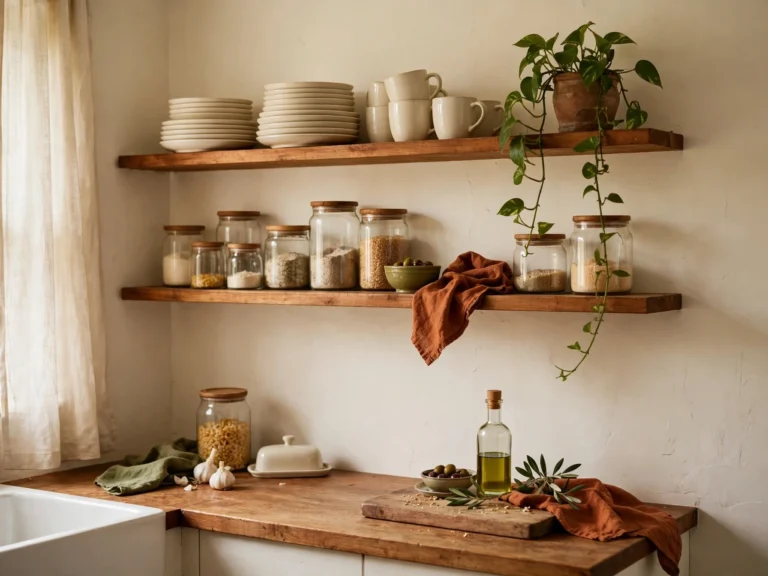
One floating shelf above the counter holds the things you reach for all day — mugs, small bowls, spices, and a plant — and keeps them off the counter without hiding them in a cabinet.
Keep the shelf at eye level, so you can reach it without a step stool, and leave some empty space at each end so it looks calm rather than crammed. A wooden shelf warms up a white kitchen.
Practical note: Anchor the shelf properly into a stud or use fixings rated for the weight. Never overload it with heavy pots or stacks of plates.

Drawers & Small Zones
11. Divide Every Drawer with Inserts
An undivided drawer is where utensils go to tangle. Drawer dividers — adjustable bamboo inserts or small trays — give every tool its own slot, so the spatula is never under the whisk and the measuring spoons are never lost.
Start with the utensil drawer, then do the junk drawer. Keep the dividers shallow enough that the drawer still closes easily, and leave one small empty section for the odd item with no home yet.
Practical note: Adjustable bamboo dividers fit most drawers without measuring. For a full drawer plan, see our kitchen drawer organization ideas.

12. Tame the Under-Sink Cabinet
The cabinet under the sink is the messiest spot in most small kitchens, because pipes make it awkward and cleaning supplies pile up there by default. A small caddy with a handle holds your everyday sprays and cloths so you can lift them all out at once.
Add a tension rod across the cabinet so spray bottles can hang by their triggers, and keep a small bin underneath for spare sponges. Keep only cleaning supplies here.
Practical note: A two-tier shelf that fits around the pipes doubles the space. For more under-sink ideas, see our under kitchen sink organization ideas.

13. Use the Fridge Door and Sides for Storage
The outside of the fridge is free storage that most kitchens ignore. Magnetic hooks on the side hold oven mitts and tea towels, while a slim magnetic caddy holds the seasonings you reach for daily.
Inside, the door shelves are best for condiments and jars, not milk or eggs, which need the coldest part of the fridge. Keep the fridge front clear of clutter.
Practical note: Do not overload the fridge door with heavy jars; the door seal wears out faster when it carries too much weight.

14. Add a Rack to the Inside of a Pantry Door
The inside of a pantry or cabinet door is a hidden shelf. A slim rack mounted there holds spice jars, small packets, and bottles that would otherwise crowd a shelf, and it keeps them visible every time you open the door.
Choose a rack shallow enough for the door to close fully, and keep the heaviest items at the bottom. If you cannot drill, look for an over-the-door rack that hooks over the top instead.
Practical note: Measure the gap between the door and the shelf behind it before buying, so the rack does not bump the shelf when the door closes.

15. Create an Appliance Garage and Rotate Appliances
Small appliances eat counter space, and a small kitchen cannot afford to display them all. Pick one or two daily appliances — usually the kettle and the coffee maker — and give the rest a home in a cabinet or an appliance garage, a small cupboard that hides the toaster and blender until you need them.
Rotate appliances by season, so the slow cooker is handy in winter and the blender is handy in summer. When you bring an appliance out, put it back the same day, or it becomes permanent counter clutter.
Practical note: Store heavy appliances at waist height, never on a high shelf where lifting them down is a strain.

Renters & Budget Fixes
16. Use No-Drill Hooks and Removable Organizers
Renters can organize a small kitchen without drilling a single hole. Removable adhesive hooks hold mugs, towels, and utensils on the wall or inside a cabinet door, and they peel off cleanly when you move.
Over-the-door hooks add storage to pantry doors, and a freestanding shelf creates storage inside a cabinet without a screw. Test one hook with a light item first, and follow the weight limit on the packet.
Practical note: Clean the wall with a dry cloth before sticking a hook on, and wait an hour before hanging anything heavy from it.

17. Add Tension Rods for Hidden Storage
A tension rod is the cheapest organizer in a small kitchen. Across the under-sink cabinet it holds spray bottles, under a cabinet shelf it hangs mugs by their handles, and across a drawer it divides lids from pots.
Tension rods need no tools and no holes. Measure the gap, choose a rod that extends a little beyond it, and twist it tight until it holds firm. If a rod keeps slipping, wrap shelf liner around each end for grip.
Practical note: Keep tension rods away from heavy items. They are best for light things — sprays, mugs, lids, and foil — not full pots and pans.

18. Organize on a Budget with Dollar-Store Bins
You do not need matching designer bins to have an organized kitchen. Small plastic bins and baskets from a dollar store do the same job: they group like items together and stop things sliding around.
Use one bin per group — snacks, baking supplies, lunchbox items — and label each one so everyone puts things back in the right place. Choose bins that fit your shelves, and keep the colours calm and similar.
Practical note: Buy bins after measuring your shelves, not before. For budget-friendly finds, our Black Friday checklist and our black Friday on a budget home decor help you stock up without overspending.

19. Follow the One-In, One-Out Rule
Organization fails when new things keep arriving and nothing leaves. The one-in, one-out rule fixes that: every time a new mug or gadget comes into the kitchen, an old one goes out — to a donation box or the bin.
Keep a small donation box in a hallway cupboard, and drop the outgoing item straight into it. Review the box once a month and take it to a charity shop. The rule works best when the whole household knows it.
Practical note: Apply the rule to gifts too. A new gadget is lovely, but if it replaces a tool you already use, let the old one go the same week.

20. Do a Ten-Minute Weekly Reset
Even the best system drifts without a short weekly reset. Once a week, spend ten minutes putting things back in their zones, wiping the shelves and the counter, and checking the fridge for food past its best.
Pick a fixed time — Sunday evening works well — and set a timer for ten minutes. When the timer rings, stop. A short reset you actually do every week beats a long clean you keep putting off.
Practical note: Keep a small caddy with a cloth, a spray, and a bin bag ready, so the reset starts the moment you pick it up.

5 Small Kitchen Organization Tips That Keep It Working
- Start with one zone, not the whole kitchen. Finish one cabinet completely before you start the next. A finished zone motivates you; five half-finished zones overwhelm you.
- Label everything you share. Labels stop other people putting things in the wrong place. Keep them short, on the front, and easy to read.
- Keep the sink empty at night. A clear sink in the morning sets the tone for the whole day. Wash up before bed, and the kitchen greets you tidy.
- Store by frequency, not by category. Daily items live at hand height near where you use them; monthly items live high or low. Frequency beats neat categories every time.
- Leave breathing room on every shelf. A shelf that is 80 percent full is easy to use; a shelf that is 100 percent full is a pile.
For seasonal kitchen styling once the organization is done, our Christmas kitchen decor ideas and our Halloween kitchen decor for apartments show how to decorate a tidy kitchen without undoing the system. For autumn warmth, see our easy fall home decor ideas for 2026 and our DIY fall home decor ideas under 50.
Small Kitchen Organization FAQs
How do I organize a very small kitchen with no pantry?
Zone the cabinets, add shelf risers and a lazy Susan, use the inside of doors, and store dry food in clear stackable containers on one shelf. A rolling cart can act as a movable pantry for the items you use most.
What is the best way to organize small kitchen cabinets?
Empty one cabinet completely, then keep only what you use in that zone and move the rest elsewhere. Add a shelf riser or turntable to use the vertical space, store lids and trays upright, and label each shelf so everything goes back to the same place.
How can I organize a small kitchen on a budget?
Use what you already own first: boxes as drawer dividers, jars as containers, and tension rods as dividers. Then add cheap buys one at a time — a shelf riser, a turntable, and a few bins — instead of buying a full set at once.
How do I keep a small kitchen organized long term?
Keep the zones, follow the one-in, one-out rule, and do a ten-minute weekly reset. When something starts drifting — a tangled drawer, a crowded counter — fix that one zone the same week instead of waiting for a full reorganization.
Final Thoughts
A small kitchen does not need a renovation to feel calm. It needs zones that match how you cook, a clear counter, drawers that open to order, and a few renter-friendly fixes that cost very little.
Start with one idea from this list — the shelf riser, the drawer divider, or the ten-minute reset — and let the kitchen get easier one zone at a time. For more budget-friendly home ideas, see our cheap DIY Christmas home decor and our easy Christmas home decor for small spaces.
Save this post to your kitchen board and start with one small zone this weekend.




7 Comments