
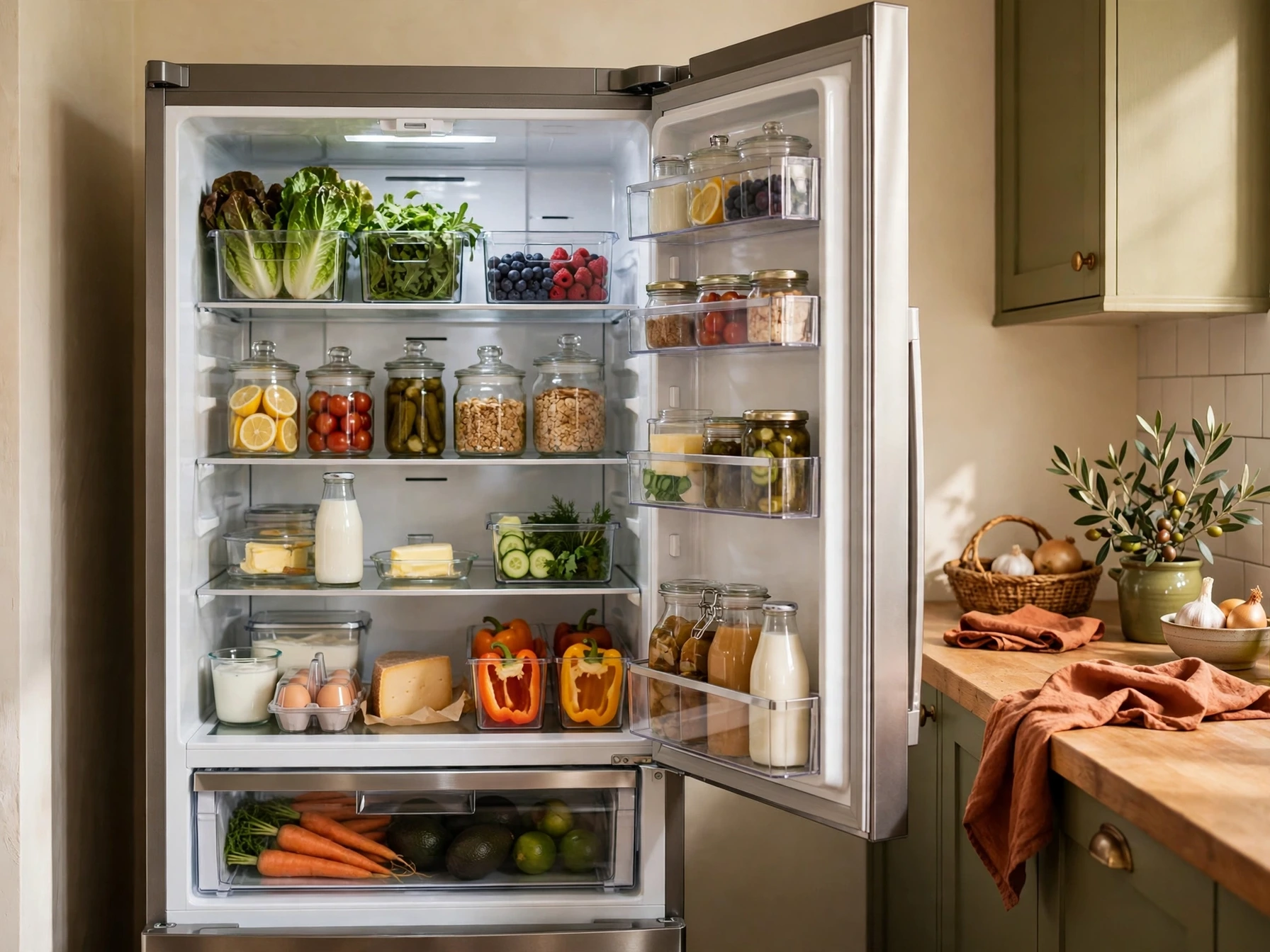
A fridge does not get messy all at once. It happens one item at a time: a jar pushed to the back, leftovers hidden behind the milk, a bag of salad forgotten in the crisper. A few weeks later you are buying food you already own and throwing away food you forgot you had.
The 15 fridge organization ideas below fix that with a simple system, not a shopping spree. Zones, clear bins, labels, and a short weekly reset are all it takes. Most of these ideas cost very little and work in any fridge, whether it is a full-size family fridge or a small apartment one. Pick one idea today, try it for a week, and add the next one only when the first has become a habit.
Why a Fridge Needs Zones, Not More Space
A fridge fails when everything lives everywhere. The yogurt is on three different shelves, the sauces are in two places, and the leftovers are behind the drinks. You spend more time moving things around than cooking, and food quietly goes bad at the back.
Zones fix that. A fridge is not evenly cold: the top shelf is the warmest, the bottom shelf is the coldest, and the door is the warmest spot of all. When each shelf has one job and each item has one home, you can see what you have in one glance, and nothing hides long enough to be forgotten.
15 Fridge Organization Ideas That Actually Work
Fridge Zones & Layout
1. Zone Your Fridge by Temperature
Sort your fridge the way cold air actually works. Cold air sinks, so the bottom shelf is the coldest and the top shelf is the warmest. Put ready-to-eat food and leftovers on the top shelf, dairy and eggs in the middle, and raw meat on the bottom shelf in a tray so nothing drips onto the food below.
This one change removes most of the daily hunting. You stop shifting jars to find the butter, and you stop wondering whether the chicken has been sitting somewhere too warm.
Practical note: Keep milk off the door. The door is the warmest part of the fridge, and milk needs steady cold. For a full zone plan for the rest of the kitchen, see our small kitchen organization ideas.

2. Give Every Shelf a Job
A shelf with no job becomes a dumping ground. Give each shelf one clear role: one shelf for dairy, one for leftovers, one for drinks, and one for the ingredients you are cooking with this week. When a shelf has a job, everyone in the house knows where things belong.
Write the job on a small removable label on the shelf edge, so the system survives even when someone else puts the shopping away. If a shelf starts drifting, it usually means its job was never clear.
Practical note: Keep the jobs simple and few. Four shelves with four jobs beat eight shelves with no plan at all.

3. Put Leftovers at Eye Level
Leftovers are the food most likely to be forgotten, because they usually end up behind something taller. Give them the best real estate in the fridge: the eye-level shelf, right at the front, in clear containers you can see through.
When leftovers sit where you look first, they get eaten instead of discovered a week later. Keep the containers small and shallow, so one meal fits in one container and you never have to dig through a deep tub.
Practical note: Eat leftovers within a few days, and always put the newest leftovers behind the older ones so the oldest gets eaten first.

4. Use the Crisper Drawers Properly
The crisper drawers are not just extra shelves. They control humidity, and that is what keeps produce fresh. Use the high-humidity drawer for leafy greens and herbs, and the low-humidity drawer for fruit and vegetables that need drier air.
Do not mix them. Fruit that releases gas as it ripens will make nearby greens wilt faster, so keep fruit in its own drawer and greens in theirs. A drawer that is too full also stops air moving, so leave a little space at the top.
Practical note: Line the bottom of each crisper drawer with a clean cloth or paper towel. It soaks up moisture and makes the weekly wipe-down much quicker.

Bins, Containers & Labels
5. Decant Into Clear Stackable Bins
Loose jars and packets slide around and hide each other. Clear bins group like items together, so you pull out one bin instead of reaching past five jars. One bin for yogurts, one for cheeses, one for sauces, and one for snacks turns a crowded shelf into four neat blocks.
Choose bins with low sides so you can see over the top, and stackable ones so you can use the height of the shelf. Clear bins also make it obvious when a group is running low.
Practical note: Measure the depth of your shelves before buying bins. A bin that is too deep will not fit, and a bin that is too shallow wastes the back of the shelf.

6. Label Every Bin and Shelf
A bin without a label is a bin that will be filled with the wrong thing by next week. Short labels on the front of each bin tell everyone in the house where things belong, and they make putting the shopping away a two-minute job instead of a puzzle.
Keep labels to one or two words: dairy, sauces, snacks, leftovers. Use removable labels or a wipeable marker, so you can change a label when the contents of a bin change with the season.
Practical note: Label the shelf edges too, not just the bins. A label on the shelf survives even when a bin is out on the counter. Renters can use removable labels that peel off cleanly — see our kitchen organization ideas for renters.

7. Add a Lazy Susan for Jars and Condiments
Jars and condiment bottles are the worst fridge clutter: small, tall, and always hiding behind each other. A turntable on a shelf — a lazy Susan — brings the back row to you with one spin, so you stop buying a second jar of something you already own.
Pick a turntable with a low rim so bottles cannot slide off, and keep the tallest bottles in the centre where they are most stable. The same trick works on a deep pantry shelf.
Practical note: Measure the shelf height before you buy. A turntable plus tall bottles needs more clearance than a flat shelf, so check the shelf above it too.

8. Keep Sauces in One Carry-Out Caddy
Sauces and condiments spread across a fridge because each one gets put back wherever there is a gap. A small handled caddy keeps them all in one place, and you can lift the whole caddy out to the table at dinner and put it back in one move.
One caddy is enough for most kitchens. Keep the sauces you use every week in it, and store the rarely used ones on the door shelf instead. When the caddy is full, it is time to use something up before buying more.
Practical note: Choose a caddy with a handle and low sides, so it slides easily between other items on the shelf and you can see every bottle at a glance.

Door, Drawers & Small Zones
9. Tame the Door Shelves
The door is the warmest part of the fridge, so it is the wrong place for milk and eggs, even though that is where many people keep them. The door is best for the things that cope with temperature swings: condiments, jams, dressings, and butter.
Give each door shelf one group, and keep the smallest items in a small bin on the shelf so they do not fall over every time the door opens. Check the dates on the door once a month, because door items are the ones that sit longest.
Practical note: Keep the door light. Heavy jars strain the door seal over time, and a door that does not seal properly makes the whole fridge work harder.

10. Use the Freezer Like a Second Fridge
The freezer is not a place where food goes to be forgotten. Treat it like a second fridge with its own zones: one area for meals, one for bread and baking, and one for frozen vegetables and fruit. Flat-freeze soups and sauces in bags, label each bag with its contents and the date, and stack them upright like files.
Freezing in meal-size portions means you only thaw what you will actually eat. A full freezer also holds its temperature better than an empty one, so keeping it sensibly full is good for the food and the fridge.
Practical note: Label every bag before it goes in, not after. A frozen bag with no label is a mystery meal, and mystery meals stay in the freezer.

11. Line Shelves for Easy Wipe-Downs
Spills are the reason fridge shelves get sticky and grimy, and a sticky shelf makes the whole fridge feel dirty. Washable shelf liners catch the drips, so a spill means lifting out a liner and rinsing it instead of scrubbing a shelf.
Cut the liners to fit each shelf, and keep a spare set so you can swap a dirty one for a clean one in seconds. Liners also stop jars from sliding around when the door opens and closes.
Practical note: Do not cover the vents at the back of the fridge with liners. Cold air needs to circulate, and blocked vents make some shelves too warm.

12. Keep a “Use First” Box
Every fridge has food that is nearly out of time: half a tub of yogurt, the last of the cream cheese, a bag of salad with two days left. A small open box marked use first gathers all of it in one place, so you check the box first when you are deciding what to cook.
Move items into the box the moment you notice their date, not the day they expire. When the box is empty, the fridge is in good shape; when it is full, tonight’s dinner should start from the box.
Practical note: Keep the box small and at eye level. A big box becomes just another shelf, and a box hidden at the back defeats its own purpose.

Upkeep & Habits
13. Do a Five-Minute Weekly Fridge Reset
Even the best fridge system drifts without a short weekly reset. Once a week, spend five minutes checking the use first box, tossing anything past its best, wiping one shelf, and putting anything stray back in its zone.
Pick a fixed day, ideally the day before your main shop, so the fridge is clear and you know exactly what you need. Five minutes you actually do every week beats a long deep clean you keep putting off.
Practical note: Keep a cloth and a small spray bottle under the sink for the reset, so it starts the moment you open the fridge. For a full cleaning plan, see our under kitchen sink organization ideas.

14. Shop with a Fridge List
Most fridge chaos starts at the shop, not in the kitchen. Before you shop, open the fridge and check what is actually there, then write a short list of only what is missing. A list stops you buying a third jar of pasta sauce and a second bag of salad you already own.
Snap a photo of the fridge shelves on your phone before you leave, so you can check it in the shop when you are not sure. The photo takes five seconds and saves a lot of guessing.
Practical note: Keep the list short and grouped by shelf zone — dairy, produce, leftovers — so putting the shopping away takes minutes. For pantry planning that pairs with this, see our kitchen storage ideas without a pantry.

15. Keep a Simple Fridge Inventory on the Door
A small list on the fridge door ends the guessing about what is inside. A magnetic whiteboard or a sheet of paper held with magnets lists the meals, the leftovers, and the items running low, and you cross things off as you use them.
Update the list when you put the shopping away, not when you remember later. The list is most useful for the items you cannot see at a glance — the freezer meals, the back of the bottom shelf, and the things in the crisper drawers.
Practical note: Renters can use a magnetic board that needs no holes or fixings at all. For more renter friendly fixes, see our kitchen organization ideas for renters and our kitchen cabinet organization ideas.

5 Fridge Organization Tips That Keep It Working
- Start with one shelf, not the whole fridge. Finish the top shelf completely before you start the next. A finished shelf motivates you; a whole fridge emptied onto the counter overwhelms you.
- Store by frequency, not by category. Daily items live at eye level where you reach them; monthly items live high or low. Frequency beats neat categories every time.
- Keep the front clear. What you see gets eaten. Push the oldest food to the front and the newest to the back, every time you put shopping away.
- Leave breathing room on every shelf. A fridge that is packed solid cannot circulate cold air properly, and food at the back stays too warm. A shelf that is 80 percent full is easy to use; a shelf that is 100 percent full is a pile.
- Wipe spills the day they happen. A spill left for a week becomes a stain. A spill wiped the same day takes ten seconds and keeps the whole fridge feeling fresh.
For a tidy kitchen beyond the fridge, see our kitchen counter organization ideas. For autumn warmth once the kitchen is organized, see our easy fall home decor ideas for 2026 and our pumpkin home decor ideas.
Fridge Organization FAQs
How do I organize a fridge with no extra space?
Zone the shelves by temperature, give every shelf one job, and use clear bins to group like items. Move milk and eggs off the door into the cold middle shelves, and use the door only for condiments. A turntable for jars and a use first box for food near its date add order without taking any extra space.
What should never go in the fridge door?
Milk and eggs should never live in the door, because the door is the warmest part of the fridge and its temperature swings every time it opens. Keep milk and eggs on a middle shelf where the cold is steady, and save the door for condiments, jams, dressings, and butter.
How long do leftovers last in the fridge?
Most cooked leftovers are best eaten within a few days. Store them in clear, shallow containers at eye level so you can see them, label the container with the day you cooked it, and always eat the oldest leftovers first. If you cannot eat something within a few days, freeze it in a meal-size portion instead.
How can I keep a fridge organized long term?
Keep the zones, label the bins, and do a five-minute weekly reset. When something starts drifting — a crowded shelf, a full door, a forgotten crisper drawer — fix that one zone the same week instead of waiting for a full reorganization.
Final Thoughts
A tidy fridge does not need a bigger fridge. It needs zones that match how cold air works, bins that group like with like, labels that everyone can follow, and a five-minute reset once a week.
Start with one idea from this list — the temperature zones, the use first box, or the weekly reset — and let the fridge get easier one shelf at a time. For more budget-friendly home ideas, see our small kitchen organization ideas.
Save this post to your kitchen board and start with one shelf this weekend.


One Comment